
Publications
You can also find my articles on my Google Scholar profile.
Preprints
Federated Learning of Nonlinear Temporal Dynamics with Graph Attention-based Cross-Client Interpretability
abs paper
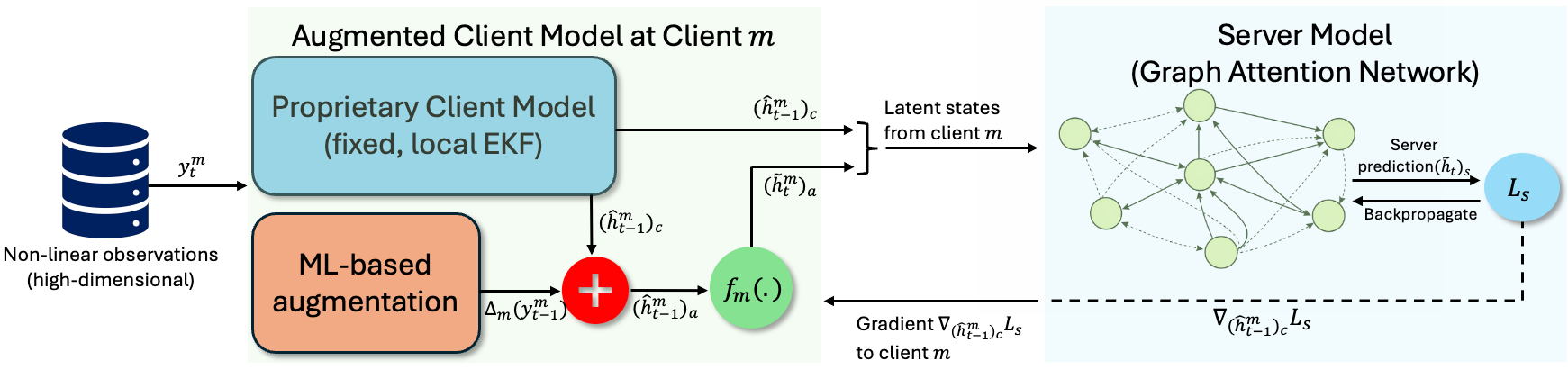
Networks of modern industrial systems are increasingly monitored by distributed sensors, where each system comprises multiple subsystems generating high dimensional time series data. These subsystems are often interdependent, making it important to understand how temporal patterns at one subsystem relate to others. This is challenging in decentralized settings where raw measurements cannot be shared and client observations are heterogeneous. In practical deployments each subsystem (client) operates a fixed proprietary model that cannot be modified or retrained, limiting existing approaches. Nonlinear dynamics further make cross client temporal interdependencies difficult to interpret because they are embedded in nonlinear state transition functions. We present a federated framework for learning temporal interdependencies across clients under these constraints. Each client maps high dimensional local observations to low dimensional latent states using a nonlinear state space model. A central server learns a graph structured neural state transition model over the communicated latent states using a Graph Attention Network. For interpretability we relate the Jacobian of the learned server side transition model to attention coefficients, providing the first interpretable characterization of cross client temporal interdependencies in decentralized nonlinear systems. We establish theoretical convergence guarantees to a centralized oracle and validate the framework through synthetic experiments demonstrating convergence, interpretability, scalability and privacy. Additional real world experiments show performance comparable to decentralized baselines.
EPOCH: Coverage-Aware Evolution with Experiential Preference Optimization for LLM-based Automated Heuristic Design
abs paper
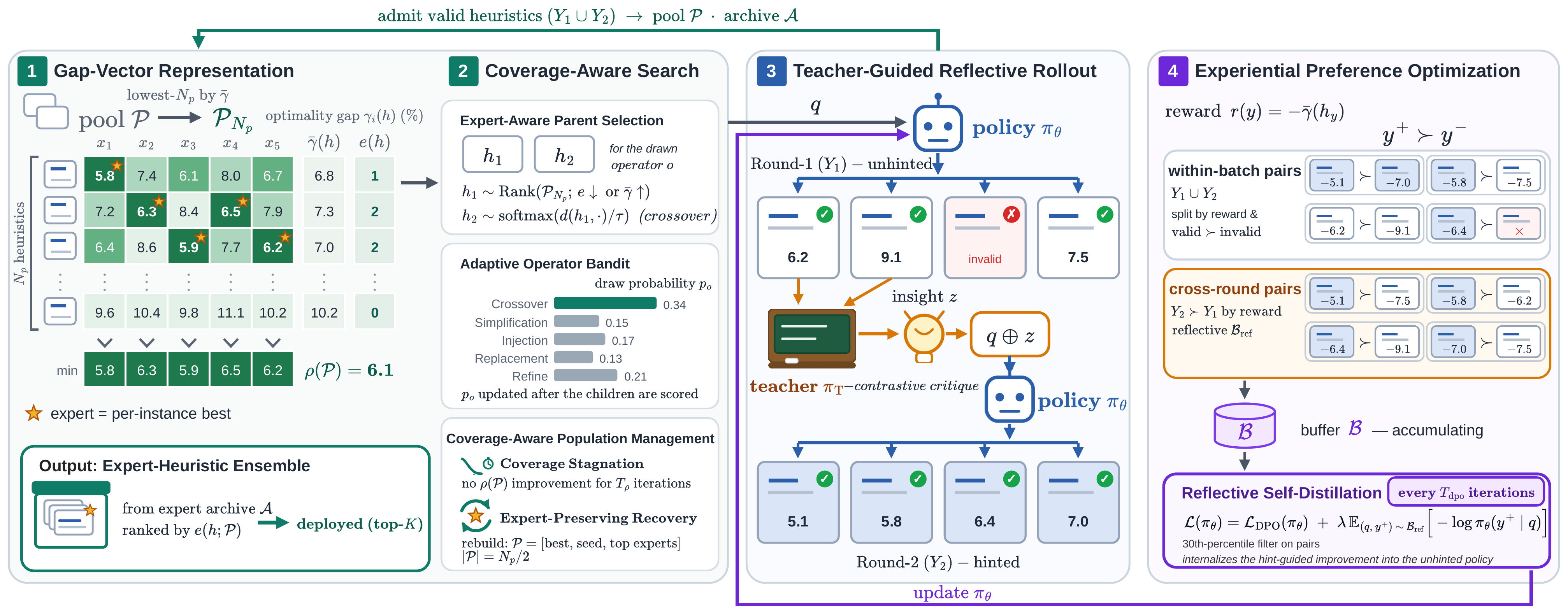
LLM-based automated heuristic design (AHD) discovers executable heuristics for NP-hard combinatorial optimization problems (COPs), where a large language model (LLM) generates candidate heuristics inside an evolutionary search. In existing frameworks, the generator either stays frozen or is fine-tuned on a scalar fitness signal that cannot show which instances each heuristic covers. Reflection-based frameworks improve heuristics with natural-language feedback, but the feedback stays in the prompt and the generator itself does not learn from it. We propose EPOCH, which sets instance coverage as the objective of the evolutionary search and fine-tunes the generator to internalize reflection. Parent selection, operator allocation, and stagnation recovery all optimize how well the heuristics jointly cover the training instances, so the search returns a complementary ensemble of heuristics. The generator learns from its own search through experiential preference optimization. A teacher LLM returns a natural-language insight on the generated heuristics, and the generator produces new heuristics with this insight. The resulting improvements join the preference pairs used for direct preference optimization (DPO). Because DPO only teaches the generator to rank these improvements, a reflective self-distillation (RSD) term makes it more likely to generate them on its own, and the gains accumulate over the long horizon of the evolutionary search. In experiments across COPs and open-source LLM backbones, the heuristic ensembles discovered by EPOCH outperform inference-only and fine-tuned LLM-based AHD baselines and generalize across problem scales.